
An office move in South Africa takes as long as its critical path: the chain of tasks that must finish before your team can work in the new premises. Moving day is only part of that programme; premises readiness, connectivity, access and testing determine the usable completion date. Set your move date from confirmed dependencies, not from the time needed to transport furniture.
TL;DR
- How long does an office move take? Separate transport time from the full office relocation programme.
- Your workplace is ready when people can work, not simply when furniture arrives.
- Build your 2026 moving timeline around premises readiness, connectivity, building access and operational testing.
- For a Giant Leap office-move enquiry, define the required outcome before requesting a date.
How long does it take to move offices in South Africa?
Your office relocation programme should run from the first necessary preparation task to the point when the new workplace supports normal operations. The physical move sits inside that programme. Treating those as the same deadline leaves essential work outside the schedule.
Start by separating these milestones. If you are approaching Giant Leap, use the same distinctions in your initial brief so that a discussion about timing has a clear scope.
Premises ready
- What it means: Required work is complete and the space can receive the move
- What it does not establish: Staff can necessarily start work
Physical move complete
- What it means: Furniture, equipment and packed contents have reached their destinations
- What it does not establish: Connectivity and equipment work correctly
Operational readiness
- What it means: Agreed work activities function in the new office
- What it does not establish: The former office has been handed back
Relocation closed
- What it means: Outstanding relocation tasks and the agreed exit obligations are complete
- What it does not establish: Every later workplace improvement is finished
A useful 2026 office-move schedule gives each milestone an owner and an acceptance condition. For example, receiving the keys establishes access; it does not establish that workstations, network connections or meeting facilities are usable.
Ask for a programme with separate readiness and transport dates. A single completion date hides which outcome the date actually promises.
Why this matters
A furniture delivery deadline and a business reopening deadline answer different questions. Your facilities team needs to know when the building can receive deliveries, while employees need to know when and where they can work.
When those dates are blurred, decisions become circular. The mover waits for access confirmation, the technology team waits for the layout, and staff receive a return-to-office instruction before the workplace has passed its checks.
Define completion in practical terms: which teams must operate, which systems they need, and which spaces must be ready. That definition is the basis for judging every proposed move date.
Build the timeline from readiness backwards
Use a dependency-based sequence rather than choosing a convenient date and fitting everything around it. Independent tasks can run together; dependent tasks need a clear handover before the next activity starts.
Define readiness
Write down what your organisation must be able to do on its first working day. Include essential workstations, connectivity, access credentials, shared equipment and any work areas needed for immediate operations.
Distinguish essential opening requirements from improvements that can follow. This keeps a non-essential finishing task from being confused with a genuine barrier to reopening.
Confirm premises
Check when the new premises can receive contractors, furniture and equipment. Confirm the status of any work that affects installation, circulation or safe occupation, and identify who signs it off.
Do not treat a planned handover as a completed handover. Your programme needs to show what happens if the agreed readiness condition has not been met.
Confirm access
Obtain the delivery and removal conditions for both buildings. Ask about loading arrangements, lift bookings, vehicle restrictions, permitted working periods and the process for admitting the moving team.
These are building-specific questions, not assumptions to make from a South African location alone. Record the actual conditions against the relevant task in your 2026 programme.
Move contents
Prepare an agreed inventory and destination plan before loading begins. Label contents so that the moving team can place them without waiting for repeated decisions at the destination.
Keep equipment required for immediate work identifiable. A box reaching the correct floor is not the same as its contents reaching the person who needs them.
Test operations
Check essential services before employees depend on them. Test the actual work activities your readiness definition requires, rather than stopping at confirmation that equipment has power.
Log failures with an owner and a resolution decision. Your reopening decision should reflect those results, not the appearance of a fully furnished office.
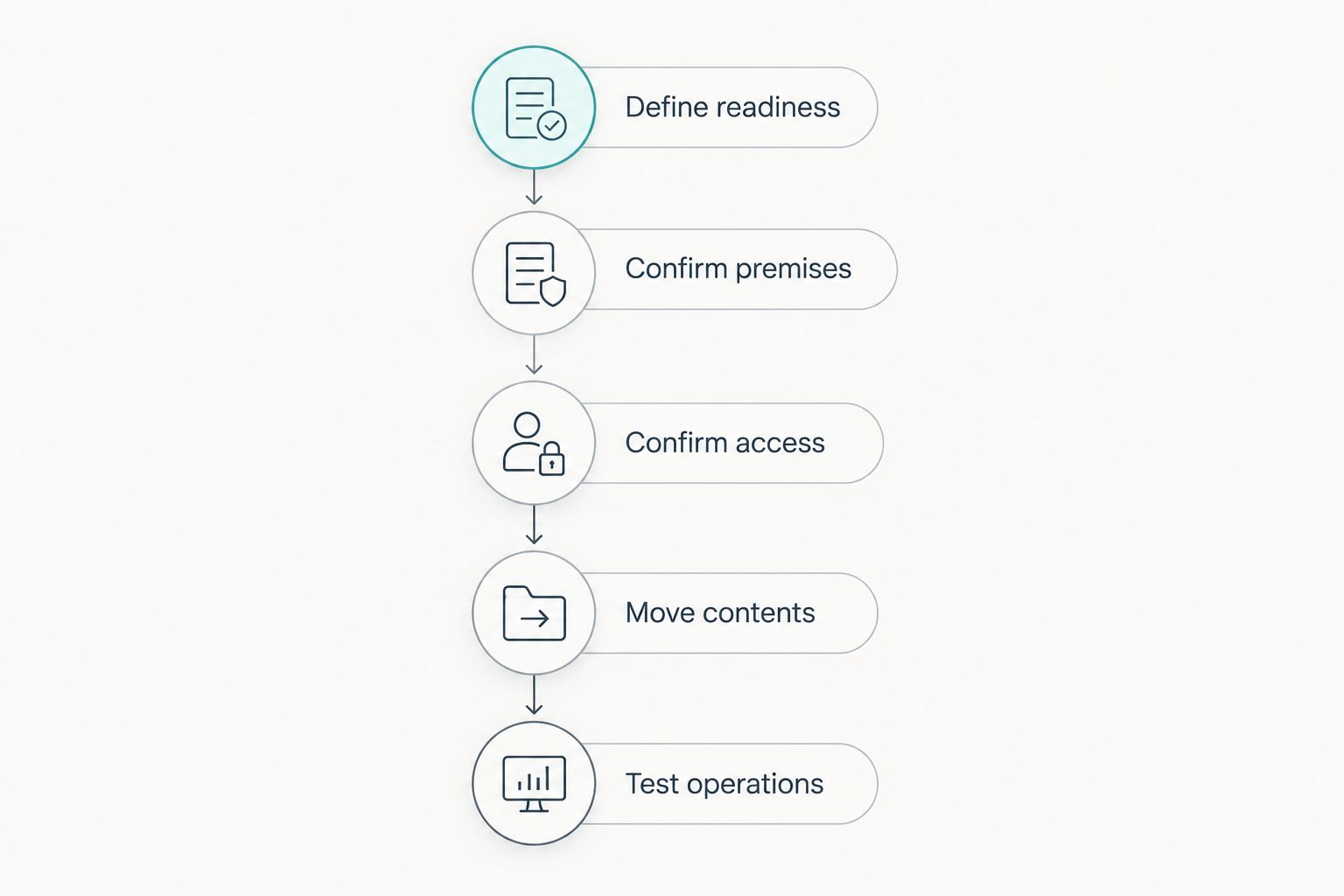
The physical move is one stage of the relocation programme, not its completion test.
The sequence gives your planning conversations a useful test: what must be true before this task can start? If nobody can answer, the task needs clarification before its date becomes a commitment.
Why office-move timelines vary
The main scheduling question is not simply how much furniture you own. It is how much work must happen, which tasks depend on others, and when the people and premises involved are accessible.
Check these factors against your own relocation:
- Premises condition: Required alterations, installation work or unresolved defects become dependencies when they affect occupation or equipment placement.
- Contents and handling: The inventory determines what needs packing, dismantling, protection, transport and reassembly. Identify unusual handling requirements before the move is scheduled.
- Technology dependencies: Connectivity, network equipment, access systems and shared devices need their own preparation and testing tasks. Confirm responsibility for each handover.
- Building access: Loading space, lift use and permitted delivery periods shape the physical sequence. Obtain conditions for the old and new buildings separately.
- Business continuity: Your need to maintain customer service or internal operations determines whether teams can move together or require a phased arrangement.
- Exit obligations: The old office can remain part of the programme after the new office opens. Check the lease and agreed handback requirements rather than assuming departure completes the exit.
Use this list to explain the proposed duration, not to attach an arbitrary allowance to every item. A task belongs on the critical path only when delaying it delays the required completion milestone.
Choose what can stop and what must continue
Your moving plan needs an explicit decision about business interruption. Without it, a transport arrangement can quietly become an operational decision that nobody approved.
Identify work that must continue during relocation, then decide how it will be supported. Use arrangements your organisation can actually provide; do not assume that every role can work remotely or that every employee has suitable equipment elsewhere.
Ask department leads to confirm:
- Which activities cannot stop during the move.
- Which equipment or records those activities require.
- Who can authorise a temporary change in working arrangements.
- What must be tested before the team returns.
A phased move offers continuity only when the split operation is workable. It also creates coordination tasks between locations, so do not select it solely because it sounds less disruptive.
For your 2026 plan, document the reopening decision separately from the removal booking. That makes it clear who can confirm that the workplace is ready for employees.
What should you ask before accepting a move date?
A credible date needs a defined scope, named dependencies and clear responsibility. Ask for these details in writing so that everyone is discussing the same job.
What does completion include?
Specify whether the date covers transport, unpacking, furniture assembly, equipment reconnection, operational testing or other agreed work. Do not assume that a task is included because it happens near moving day.
The useful answer describes a finished state. A statement that everything will be moved is less precise than a statement identifying what will be placed, assembled and checked.
Which dates are confirmed?
Separate confirmed bookings from provisional dates and requested dates. A building-access request and an approved access booking are different scheduling conditions.
Give each unresolved dependency an owner. The programme should show who must secure confirmation before the next commitment is made.
What happens if a dependency slips?
Agree how the move team will respond if premises, access or essential systems are not ready. Identify the decision-maker and the point when a revised arrangement must be communicated.
A contingency is useful only when it describes an action. Simply adding spare time does not resolve an unavailable loading area or an untested connection.
Prepare a brief that produces a useful timeline
Before requesting a relocation programme, assemble the facts that determine its scope. A concise brief is more useful than a preferred date with no supporting detail.
Include your origin and destination, an inventory, the status of the new premises, building-access requirements and the activities that must continue during the move. Add your required opening condition and identify any dates already fixed by agreements or bookings.
For a Giant Leap office-move enquiry, lead with scope and readiness requirements rather than a date alone. Use the contact page to start that discussion, and ask which parts of the proposed scope can be addressed.
Keep the same brief available to everyone involved. If the inventory, layout or access conditions change, update the programme rather than allowing different teams to plan against different versions.
Can you move offices over a weekend?
A weekend move works only when access, preparation, staffing and testing fit the permitted working period. Choosing a weekend does not remove tasks from the relocation programme.
Check both buildings and every required service provider before committing. Your return-to-work decision still needs an operational test, even when the furniture arrives outside normal working hours.
Does a larger office always take longer to move?
Office size alone does not determine the relocation programme. Compare the inventory, handling requirements, building conditions and operational dependencies instead of relying on floor area or employee count.
A straightforward inventory and clear access create a different planning task from specialist equipment and restricted deliveries. Ask the programme to explain those differences explicitly.
When should employees receive their move instructions?
Employees should receive move instructions once the arrangements affecting their actions are confirmed. Separate early preparation guidance from the final instruction about where and when to work.
Tell employees what to pack, what to keep accessible, how to label belongings and whom to contact about problems. Issue updates when a changed dependency affects those instructions.
FAQ
How long does an office move take from planning to reopening?
An office move runs from the necessary preparation tasks through to operational readiness. Build the duration from confirmed premises, access, transport and testing dependencies rather than treating moving day as the whole project.
Is moving day the same as the office reopening date?
Moving day is not automatically the office reopening date. Reopening depends on whether the workspace and essential services support the activities your employees need to perform.
What should I confirm with building management before moving?
Confirm loading arrangements, lift bookings, permitted working periods and entry procedures for both buildings. Record approvals before treating the related move tasks as confirmed.
Can staff keep working during an office relocation?
Staff can keep working only where an agreed arrangement supports their roles and required systems. Identify activities that must continue and confirm the equipment, access and responsibilities they need.
What is the critical path in an office move?
The critical path is the chain of dependent tasks that determines the required completion date. A delay to a task on that chain delays completion unless the programme changes.
What information should I prepare for an office-move enquiry?
Prepare the origin and destination, inventory, premises status, access conditions and operational requirements. State what must be working at reopening and identify dates already fixed by agreements or bookings.
Should the old office handback be included in the move programme?
Include the old office handback when exit obligations remain part of the relocation. Opening the new workplace does not itself establish that the former premises meet the agreed handback conditions.
One last thing
Test a working day, not just a working socket. Before reopening, check whether a person can enter the building, reach the correct workspace, connect to required systems and complete an essential work task.
Use that practical test as your final 2026 readiness check. Furniture in place is visible progress; a functioning work activity is evidence that your office can reopen.