
A medical practice renovation takes as long as its agreed scope, approval requirements, procurement and site access allow; there is no reliable duration that applies to every practice. The construction period also excludes work that happens before the site opens and checks needed before patients return. For a usable 2026 estimate, ask for separate dates for design, approvals, construction and clinical reopening rather than accepting a single completion date.
TL;DR
- How long to renovate a medical practice depends on scope, approvals, procurement and whether patients remain on site.
- Separate construction completion from clinical reopening; finishing the building work does not complete every operational task.
- For a discussion with Giant Leap, bring a written scope and request a project-specific renovation programme.
- Compare phased work with a full closure using patient access, disruption and handover requirements—not duration alone.
Why this matters
Your practice needs a date it can plan around, not an estimate that starts after the difficult decisions have already been made. A contractor's site period and your total period of disruption are different measures.
Before discussing a project with Giant Leap, define what must change and what must keep operating. The most useful renovation estimate names its starting point, its finishing point and the conditions attached to both. That distinction matters more than an unsupported promise of a quick turnaround.
How long does it take to renovate a medical practice?
Build the answer around a sequence of milestones rather than a generic allowance. For your 2026 programme, ask the project team to identify which activities must finish before the next activity starts and which can run alongside each other.
Use these 5 milestones to structure the discussion:
- Scope agreed. Confirm the rooms, services, equipment and operational changes included in the renovation. Record exclusions so that an apparently short programme does not hide unfinished work.
- Design agreed. Resolve the layout, room functions, materials and service requirements before treating the construction sequence as settled.
- Approvals resolved. Establish which permissions or reviews apply to the actual works. Record who submits information, who responds to questions and what must be resolved before work proceeds.
- Construction completed. Define whether this means physical installation, completion of defects, testing, or a particular contractual milestone. Do not let different parties use the same phrase for different outcomes.
- Clinical reopening. Allow for the practice's own readiness requirements, including cleaning, equipment setup, systems checks and staff preparation relevant to the changed space.
A useful programme also shows dependencies. If equipment specifications affect cabinetry or electrical work, those specifications need resolving before the affected installation—not at the end of the project.
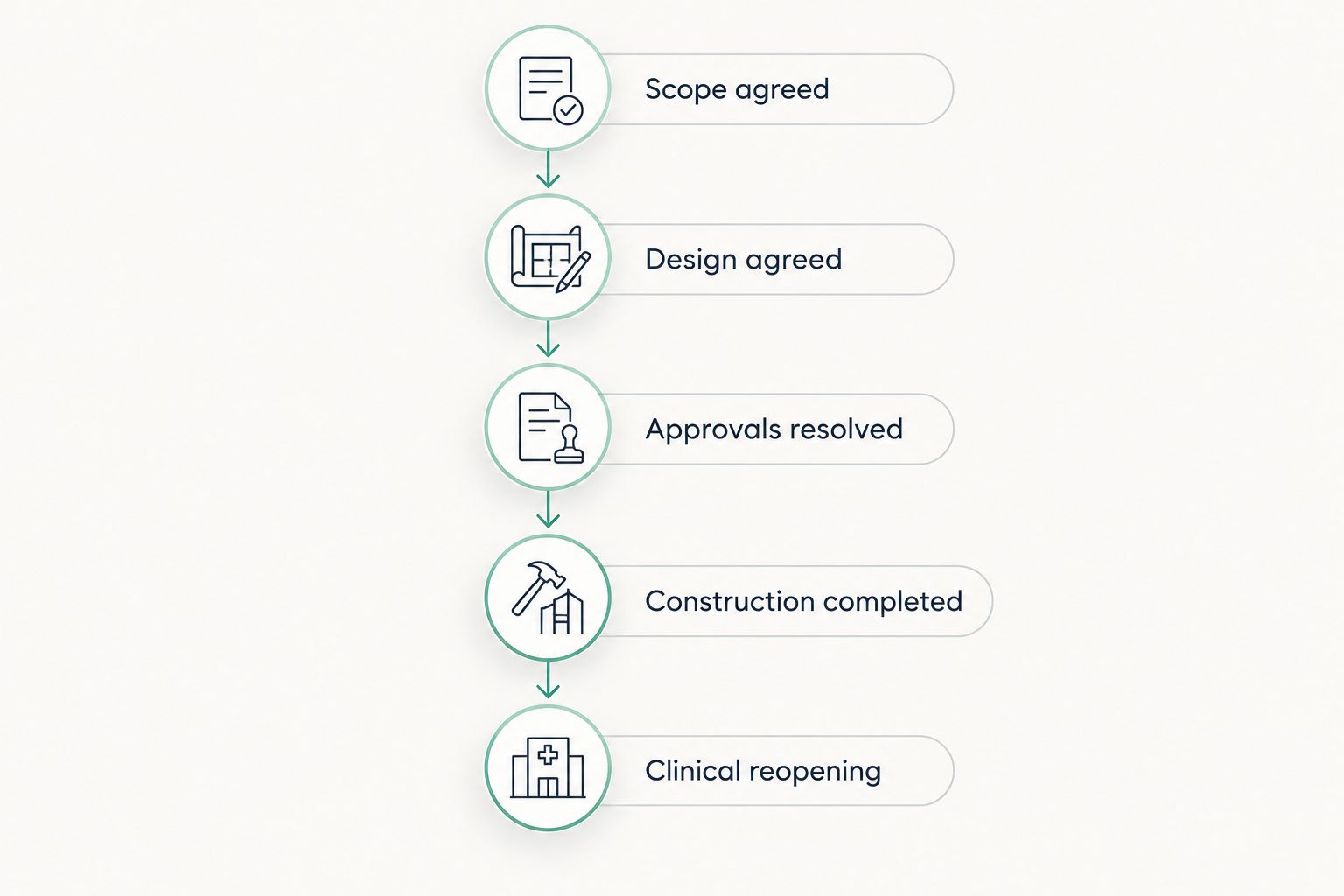
Construction completion and clinical reopening are separate milestones.
Cosmetic refresh: keep the scope tightly defined
Best for: practices changing finishes without changing how rooms function. A cosmetic refresh can include repainting, replacing selected finishes or updating furniture, provided the work does not introduce wider changes to the building or its services.
Its planning advantage is a narrower scope. Its limitation is equally important: new finishes do not solve an unsuitable room layout, insufficient storage or a problematic patient route.
Ask the project team to confirm what the refresh leaves untouched. If an inspection reveals work beneath a finish, record the effect on the programme before adding it to the job. Calling a project cosmetic does not make every task simple.
Vacant-practice renovation: remove patient access from the work area
Best for: practices that can stop using the affected premises during construction. Working in a vacant practice removes the need to route patients through the same space while the renovation proceeds.
The trade-off is operational interruption. Your planning must cover where appointments take place, how staff work and when equipment moves—not just when trades can access the premises.
Set the reopening conditions before agreeing the closure date. A finished reception desk is not enough if essential rooms, equipment or communication systems are not ready for use.
Phased renovation: protect operations with a clear sequence
Best for: practices that must retain some on-site activity. Phasing divides the works into areas or stages so that the project team and practice can agree where clinical activity continues.
The benefit is continuity in the areas that remain usable. The constraint is coordination: boundaries, access, noise, dust control and service interruptions need explicit arrangements appropriate to the works.
Phasing does not automatically mean a shorter overall renovation. Compare the full sequence, including room moves and handovers, before choosing it simply to avoid a complete closure.
Cosmetic refresh
- Best for: Changes to finishes without functional redesign
- Planning advantage: A tightly bounded scope is easier to describe
- Main limitation: Existing layout or service problems remain outside scope
Vacant-practice renovation
- Best for: Work in premises not receiving patients
- Planning advantage: Patient activity does not share the construction area
- Main limitation: The practice needs an operational closure or relocation plan
Phased renovation
- Best for: Maintaining agreed activity on site
- Planning advantage: Usable areas can remain separate from planned works
- Main limitation: Access restrictions and repeated handovers complicate sequencing
Why medical practice renovation timelines vary
The duration follows the work and its dependencies. For a 2026 project, focus the scheduling discussion on these factors rather than comparing your practice with an unrelated refurbishment.
- Scope and layout changes. Replacing a finish is a different task from moving a room boundary or changing a room's function. Agree exactly which changes belong in the project.
- Existing conditions. Work behind ceilings, walls or floors depends on what is actually there. Establish what can be inspected before construction and how discoveries will be handled.
- Approval requirements. The relevant permissions depend on the property and proposed work. Ask for a project-specific approval list rather than assuming that every renovation follows the same route.
- Equipment and materials. Installation depends on confirmed specifications and delivery arrangements. Identify items that must arrive before another task can proceed.
- Clinical access. A practice that remains operational needs an agreed separation between work areas and patient activity. Restricted access affects the sequence available to the project team.
- Decisions and changes. Unresolved selections and revised instructions alter what can be built. Give each decision an owner and a required date in the programme.
Ask which dependency controls reopening. A detailed schedule is useful only when it identifies the task that prevents the practice from moving to its next milestone.
What should a renovation programme include?
Request 2 programmes: a construction programme and an operational transition programme. They should refer to the same milestones, but they answer different questions.
The construction programme explains how the physical work proceeds. It should show access arrangements, work areas, dependencies, inspections or testing relevant to the scope, and the agreed handover point.
The operational transition programme explains how your practice keeps functioning or prepares to restart. Include appointment arrangements, staff communication, equipment moves, records access and readiness checks wherever the project affects them.
For your 2026 planning meeting, use a simple ownership table. Its purpose is to prevent important tasks from falling between the contractor, the property representative and the practice team.
Site access
- Question to resolve: When can each work area be used?
- Record in the programme: Access conditions and responsible person
Design decisions
- Question to resolve: What must be selected before installation?
- Record in the programme: Decision owner and required date
Equipment
- Question to resolve: What information does the installation depend on?
- Record in the programme: Specification and delivery dependencies
Service interruptions
- Question to resolve: Which practice activities are affected?
- Record in the programme: Agreed interruption and communication plan
Handover
- Question to resolve: What does completion include?
- Record in the programme: Acceptance criteria and outstanding-work process
Reopening
- Question to resolve: Who confirms the practice is ready?
- Record in the programme: Readiness tasks and responsible people
When you discuss your renovation requirements with Giant Leap, use this distinction to frame the brief. Ask for the assumptions behind the programme as well as the proposed dates; both are necessary for a useful scheduling discussion.
Can you renovate a medical practice without closing?
Keeping 1 room operational is not the same as keeping a functioning practice open. Patients and staff still need suitable access, essential services and a workable separation from the construction activity.
Start with the clinical activities that must continue, then identify the spaces and services they require. Only after that should the team draw the boundary between the operational area and the work area.
A phased proposal should explain what happens during service interruptions and room handovers. If those arrangements are unresolved, the practice does not yet have a complete continuity plan.
Does construction completion mean you can reopen immediately?
No. Construction completion and clinical reopening are different milestones, even when they fall on the same date in the agreed programme.
Before reopening, confirm the practice-specific tasks that follow the works. These can include cleaning, checking installed equipment, restoring systems, arranging supplies and preparing staff to use changed rooms.
Give every readiness task an owner. Do not assume the building contractor is responsible for operational work unless the agreed scope explicitly includes it.
How do you get a reliable renovation completion date?
A reliable completion date needs an agreed scope and visible dependencies, not just a target opening day. Start with the date you want to receive patients and ask the project team to show what must happen before it.
For a 2026 programme, request a written list of assumptions alongside the schedule. It should distinguish confirmed arrangements from decisions still needed, particularly where approvals, specifications or access remain unresolved.
Then agree how programme changes will be recorded. A revised date without an explanation leaves you unable to judge whether appointments, staffing or relocation arrangements also need changing.
FAQ
What's the quickest way to renovate a medical practice?
The first step is to define the work precisely and resolve its dependencies before construction. Removing necessary checks is not a sound scheduling strategy; limiting unnecessary scope and late changes is a better planning approach.
How long to renovate a medical practice if I'm only changing the finishes?
A finishes-only renovation still needs a scope-specific programme covering preparation, installation, access and handover. Confirm that layout changes, building services and equipment work are genuinely excluded before treating it as a cosmetic refresh.
Is a phased renovation better than closing the practice?
A phased renovation is better suited to retaining agreed on-site activity, while a closure separates patient activity from the works. Compare operational disruption and construction sequencing before choosing either approach.
Should I book patients before the renovation is finished?
Base patient bookings on the agreed clinical reopening milestone, not construction progress alone. Confirm that the required spaces, equipment, systems and staff arrangements will be ready.
What should I ask Giant Leap about my renovation schedule?
Ask Giant Leap how the proposed scope, access arrangements and project dependencies would be reflected in a programme. Request a clear distinction between construction completion and the practice's reopening requirements.
Do all medical practice renovations need the same approvals?
No, approval requirements depend on the property and the proposed works. Have the relevant project professionals identify the requirements for your renovation before treating the construction start as confirmed.
What should I check before accepting a completion date?
Check the scope, programme starting point, access assumptions, dependencies and definition of completion. Also confirm who owns the tasks between building handover and clinical reopening.
One last thing
Define what counts as open before deciding when to reopen. A practice can look finished while a room, piece of equipment or operational system still needs attention.
Write the reopening criteria before construction begins, then use them at handover. For your 2026 renovation, that written definition gives the project team and practice staff a shared finish line—and gives you a firmer basis for making patient-facing commitments.