
Yes—sustainable office design is worth the cost when it reduces avoidable energy use, extends the life of your fit-out and supports the way your team works. The initial fit-out is only part of the decision: maintenance, replacement, installation disruption and the length of your occupation also matter. In 2026, assess each proposed improvement against a credible baseline rather than assuming that a sustainable label guarantees a financial return.
TL;DR
- Is sustainable office design worth the cost? Yes, when useful life and operating benefits justify the work.
- Retaining serviceable furniture and finishes deserves consideration before replacement.
- Efficient equipment needs suitable controls, commissioning and maintenance to deliver its intended benefits.
- Give Giant Leap an office design brief that separates essential work from optional sustainability upgrades.
Why this matters
An office refurbishment brings together decisions with different consequences. A workstation layout affects daily use; a lighting specification affects electricity consumption; a finish affects cleaning and replacement. Treating all of them as a single sustainability premium hides the choices you actually control.
For your 2026 brief, separate what the office needs from what would simply be new. When approaching Giant Leap, ask for the reasoning behind proposed replacements, not just a list of new items. That makes the discussion about function and useful life rather than labels.
Is sustainable office design worth the cost in 2026?
Sustainable office design earns its place through a better whole-life outcome, not through the label itself. Compare alternatives that meet the same workplace requirements, then examine their energy demand, maintenance, replacement needs and material use.
Start with these approaches. They are not interchangeable: a functioning office and a space with failing services need different scopes.
Retain and adapt
- Best for: Offices with serviceable furniture, finishes and layouts
- Main advantage: Keeps useful assets in service and avoids unnecessary replacement
- Main drawback: Existing dimensions or condition can limit the design
- What to verify: Condition, suitability, repair needs and compatibility
Targeted upgrades
- Best for: Offices with identifiable lighting, comfort or layout problems
- Main advantage: Directs work towards a specific operational need
- Main drawback: New components must work with existing systems
- What to verify: The problem, proposed intervention and expected operating effect
Full refit
- Best for: Offices requiring substantial changes to function or services
- Main advantage: Allows the layout, services and finishes to be planned together
- Main drawback: Creates a broader installation scope and replacement burden
- What to verify: Why retention or a smaller intervention cannot meet the brief
None of these approaches wins automatically. Retention is a poor choice if an item is unsafe or unsuitable; replacement is a poor choice if the existing item still meets the requirement. The correct comparison starts with condition and function.
Build a like-for-like comparison
A conventional proposal and a sustainability-focused proposal must solve the same problem. Otherwise, you risk comparing a basic refresh with a substantially different workplace and attributing the entire difference to sustainability.
Use the same occupancy assumptions, operating hours, comfort requirements and project boundaries. Ask each proposal to identify what stays, what changes and what performance assumptions support the recommendation.
A useful comparison should distinguish:
- Essential work: changes required to make the office suitable for its intended use.
- Performance improvements: changes intended to reduce consumption or improve operation.
- Optional finishes: aesthetic choices that do not establish an operating benefit.
- Future obligations: maintenance, consumables and eventual replacement.
This separation prevents a decorative upgrade from borrowing the financial justification of an efficient lighting system.
Retain and adapt: test existing assets first
Retaining a desk, partition or finish avoids manufacturing a replacement for that particular item. It also preserves the value of something your business already owns. That makes retention a sensible starting question, not an instruction to keep everything.
Inspect assets before the design is fixed. Check stability, surface condition, dimensions, adjustability and suitability for the proposed layout. An existing desk that obstructs circulation or cannot support the required working setup is not useful merely because it already exists.
Keep serviceable assets that meet the brief; repair or adapt where practical. Record the reason for replacing anything substantial. This turns reuse into a design decision rather than a last-minute exercise in fitting leftover furniture into a new plan.
The drawback is constraint. Retained items can restrict layouts or require repairs, and a mixed furniture inventory needs deliberate planning. Include those requirements in the comparison instead of presenting reuse as effortless.
Targeted upgrades: connect each change to a problem
A targeted upgrade is strongest when the problem is observable. Lights left on in empty rooms, inconsistent temperatures or damaged high-use finishes give you something specific to investigate.
Lighting illustrates the distinction between equipment and operation. Efficient luminaires address energy demand, while occupancy and daylight controls address when lighting is needed. The result depends on appropriate selection, installation and settings—not the product description alone.
For every proposed intervention, write down:
- The existing problem and evidence for it.
- The change intended to address that problem.
- How the new component interacts with existing systems.
- Who will check its operation after installation.
- What maintenance or user guidance it requires.
The limitation is integration. A new control that users cannot understand, or equipment that conflicts with existing services, creates another operational problem. Specify the handover and maintenance requirements alongside the equipment.
Full refit: justify the scope before the specification
A full refit lets you coordinate layout, lighting, ventilation, finishes and furniture. That is useful where the existing office no longer supports the required activities or where extensive work is already necessary.
It also involves more decisions, installation activity and potential material replacement. Calling the project sustainable does not resolve those consequences. Ask which existing elements can remain even when the wider layout changes.
For a 2026 refit, document the intended working pattern before selecting finishes. Meeting rooms, focused work and shared facilities place different demands on the space. A plan that does not match those activities can require alterations regardless of the materials chosen.
Approve the functional brief before approving the replacement schedule. Then ask for repairable components, accessible services and a clear maintenance handover where these suit the project. These features support continued use without promising an unsupported financial return.
Why the value of sustainable office design varies
The same specification does not produce the same result in every office. Your building, equipment and use patterns determine whether a proposed improvement addresses a real need.
- Existing condition: sound furniture and finishes create different opportunities from damaged or unsuitable assets.
- Operating pattern: occupied hours and room use affect the relevance of lighting and building controls.
- Lease horizon: the period you expect to occupy the office affects how you assess long-lived improvements.
- Building constraints: glazing, orientation and existing services influence which interventions are practical.
- Maintenance access: components need to be cleaned, serviced and repaired without unnecessary dismantling.
- Occupant behaviour: controls and layouts must be understandable to the people using them.
For a South African office, distinguish energy efficiency from power continuity. Reducing electricity consumption and keeping equipment operating during an interruption are different objectives. If both belong in your brief, specify and assess them separately.
How do you decide which improvements to approve?
Use a sequence that exposes assumptions before they become specifications. The aim is not to assemble the longest sustainability checklist; it is to choose work you can explain and maintain.
- Set the brief. Describe the activities the office must support, the intended occupation period and the problems that need solving.
- Inspect existing assets. Record what can remain, what needs attention and what no longer meets the requirement.
- Compare alternatives. Assess retention, targeted work and broader refurbishment against the same functional brief.
- Check assumptions. Review energy calculations, maintenance requirements and the basis for any claimed benefit.
- Plan the handover. Assign responsibility for settings, user guidance, maintenance records and post-occupation checks.
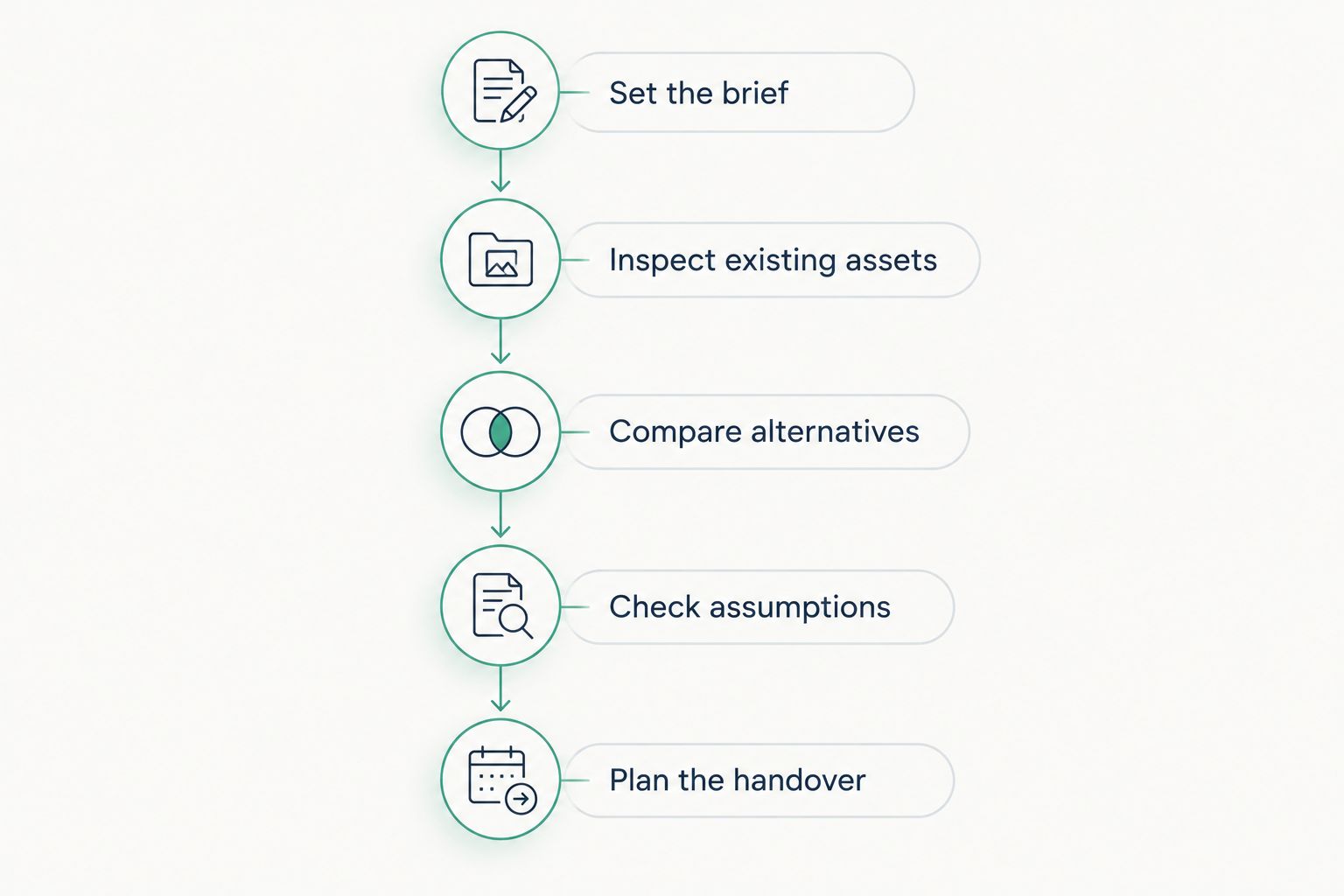
Check the assumptions before approving the specification.
Keep the comparison in a decision record rather than scattering it across presentations and supplier emails. Record the chosen option, the rejected alternative and the reason for the choice. That gives future facilities staff the context needed to maintain the intended performance.
Giant Leap is best approached by office design buyers with a brief that separates essential work from optional upgrades. Bring an asset inventory and a list of operational problems to the conversation. Ask how each proposed change responds to those requirements.
Discuss your office design brief
Bring your existing asset list, workplace requirements and questions about reuse and maintenance.
How do you judge a return without assuming savings?
Start with records you already have: electricity consumption, maintenance history, replacement records and the proposed scope of work. These establish the baseline. A forecast without a baseline is difficult to assess.
Ask for the assumptions behind projected operating benefits. Lighting calculations should reflect the proposed equipment and operating pattern; maintenance comparisons should reflect the actual components and service requirements. Do not accept a generic improvement claim as a project-specific result.
Some benefits belong outside a financial calculation. A more suitable layout or a documented material requirement can be a valid project objective without an invented productivity figure attached to it. Keep measurable operating effects separate from objectives that require qualitative assessment.
For your 2026 approval, distinguish three things: what is documented now, what is calculated for the proposal and what must be checked after occupation. This prevents an estimate from being presented as an achieved result.
Is replacing everything the more sustainable choice?
Replacing everything is not the default sustainable choice. Check whether existing items can perform the required function before specifying replacements. New materials and equipment need a reason to enter the project.
Replacement is justified when the existing item cannot meet the requirement, cannot be repaired appropriately or prevents necessary changes. Assess those reasons item by item. An attractive new specification does not establish that the old one needed removal.
Do sustainable materials guarantee a healthier office?
Sustainable materials alone do not guarantee a healthier office. Material emissions, ventilation, cleaning and moisture management are separate considerations that need attention in the brief.
Ask for documentation supporting specific material claims, including what the claim covers. A statement about recycled content does not answer a question about emissions, and a material specification does not establish that ventilation is suitable. Match each piece of evidence to the question it actually answers.
FAQ
Is sustainable office design worth the cost in 2026?
Sustainable office design is worth the cost when its useful life and operating benefits justify the work. Compare options against the same workplace brief, including maintenance, replacement and installation disruption.
Should I reuse office furniture or replace it?
Reuse office furniture when its condition, dimensions and function meet your requirements. Replace or adapt items that fail those checks rather than retaining them solely to meet a reuse target.
Does sustainable office design always reduce electricity use?
Sustainable office design does not automatically reduce electricity use. Electricity outcomes depend on the equipment, controls, settings, operating hours and existing baseline.
Can a rented office benefit from sustainable design?
A rented office can benefit from changes suited to its lease terms and occupation period. Check landlord permissions, reinstatement obligations and which improvements you can take to another premises.
Do I need certification for an office to be sustainable?
Certification is not a prerequisite for making practical sustainability improvements. If certification is a project requirement, establish the assessment criteria and evidence requirements before finalising the design.
What should I ask an office designer about sustainability?
Ask an office designer what can stay, what needs to change and what evidence supports each proposed benefit. Request the operating assumptions, maintenance requirements and handover responsibilities alongside the specification.
How should I compare sustainable office design proposals?
Compare sustainable office design proposals against the same functional scope and occupation assumptions. Separate essential work, performance improvements and optional finishes so that different project scopes do not distort the decision.
One last thing
Ask for a replacement rationale before asking for a sustainability statement. A proposal that explains why each existing element stays or goes gives you a decision you can interrogate. A list of environmental attributes does not do that on its own.
For a 2026 project, make the handover part of the brief from the start. Someone needs to understand the controls, retain the maintenance information and check that the office works as intended. Good specifications need an operating plan, not just an installation date.