
Best overall: ceiling and wall absorption. Best for confidential calls: enclosed rooms. Best targeted desk retrofit: acoustic screens. This Giant Leap guide compares the best acoustic solutions for open-plan offices 2026 by the problem each solves, including its limits.
TL;DR
- Giant Leap’s best acoustic solutions for open-plan offices 2026 guide puts ceiling and wall absorption first for reverberant spaces.
- Enclosed rooms are best for confidential conversations; absorptive panels alone do not provide speech privacy.
- Acoustic screens suit neighbouring desks, while activity zoning separates concentrated work from calls and collaboration.
- Sound masking needs professional commissioning; headphones help individuals but do not fix the shared office.
Why this matters
An open-plan office can have several different noise problems: sound lingering after someone speaks, conversations travelling between desks, and calls interrupting nearby work. Treating them as the same problem leads to the wrong purchase.
Absorption reduces reflected sound; isolation restricts sound transmission; masking reduces the intelligibility of unwanted speech. None automatically replaces the others. A quieter-sounding room can still let you understand a conversation across the office.
For your 2026 office brief, define the outcome before naming a product. Reducing room echo, protecting confidential conversations and helping people concentrate require different decisions.
What makes the best office acoustic solution?
Judge every option against these criteria before comparing finishes or choosing installation locations:
- Problem fit: Does the solution address reverberation, speech transmission or distraction? Ask for an explanation tied to your office, not a generic acoustic claim.
- Coverage and position: Treatment must intercept relevant sound paths. A decorative panel placed away from those paths is not a complete acoustic plan.
- Speech privacy: Decide whether conversations need to be less distracting or genuinely confidential. Those are different requirements.
- Work compatibility: Keep access, sightlines, ventilation and collaboration in the brief. An acoustic improvement that obstructs everyday work introduces another problem.
- Evidence and verification: Request relevant test reports and an assessment of the installed result. Material performance does not establish whole-office performance.
Best acoustic solutions at a glance
The ranking below is a decision tree, not a claim that every office needs every treatment. Start with the row that matches your main complaint.
1
- Solution: Ceiling and wall absorption
- Best for: Reverberant shared offices
- Standout feature: Reduces reflected sound across treated areas
- Key limitation: Does not establish confidential speech privacy
2
- Solution: Enclosed rooms
- Best for: Confidential calls and meetings
- Standout feature: Separates conversations from the open floor
- Key limitation: Performance depends on the entire enclosure
3
- Solution: Acoustic screens
- Best for: Speech between neighbouring desks
- Standout feature: Places a barrier close to the source and listener
- Key limitation: Sound still travels over and around screens
4
- Solution: Activity zoning
- Best for: Mixed quiet and collaborative work
- Standout feature: Separates incompatible activities
- Key limitation: Requires enough space and consistent use
5
- Solution: Sound masking
- Best for: Distracting intelligible background speech
- Standout feature: Adds controlled background sound
- Key limitation: Requires design, commissioning and adjustment
6
- Solution: Personal headsets
- Best for: Individual listening and focus
- Standout feature: Gives the wearer immediate control
- Key limitation: Leaves the shared acoustic environment unchanged
1. Ceiling and wall absorption: best for room-wide reverberation
Ceiling and wall absorption reduces sound reflected by hard surfaces. Depending on the room, treatment can include absorptive ceiling finishes, suspended elements or wall panels positioned around reflective areas.
Best for: An office where speech sounds persistent, lively or echoing throughout the shared space. Ceiling and wall absorption is the default starting point when reverberation is the main problem, not when confidentiality is the main requirement.
Ceiling and wall absorption pros
- Treats reflected sound rather than asking every employee to change behaviour.
- Can address shared areas without placing barriers between every workstation.
- Offers different mounting approaches for different ceiling and wall conditions.
Ceiling and wall absorption cons
- Does not prevent direct speech from reaching a nearby desk.
- Installation must account for lighting, services, access and the building’s requirements.
- Poor placement or inadequate coverage leaves important reflections untreated.
Ask how the proposed treatment relates to the room’s surfaces and occupied layout. Request absorption data for the proposed material, but do not treat a material rating as proof that your office will meet its acoustic brief.
Verdict: Buy ceiling and wall absorption when excessive reflected sound is the diagnosed problem.
2. Enclosed rooms: best for confidential calls and meetings
Enclosed rooms separate speech-producing activities from the open floor. They include built meeting rooms and other enclosed spaces designed for conversations, subject to their actual construction and tested performance.
Best for: Sensitive discussions, sustained calls and meetings that should not become everyone else’s background conversation. For your 2026 workplace plan, route these activities into appropriate enclosed spaces before trying to solve them with desk accessories.
Enclosed rooms pros
- Separates the sound source from nearby workstations.
- Gives teams a defined place for conversations that require privacy.
- Keeps extended discussions away from quiet work areas.
Enclosed rooms cons
- Doors, glazing, joints and ventilation paths can compromise isolation.
- Rooms occupy floor area and need suitable ventilation and access.
- Booking friction encourages people to take calls at their desks instead.
Ask for evidence covering the complete enclosure, not just a wall panel or door. A sealed-looking room is not automatically a private room; sound can follow indirect paths through adjoining construction and building services.
Verdict: Buy enclosed rooms for confidential conversations, with verified isolation and a workable access plan.
3. Acoustic screens: best for neighbouring workstations
Acoustic screens introduce a barrier between desks or groups of workstations. Absorptive screen surfaces also reduce some reflections near the work area, but barrier performance depends on the relationship between speakers, listeners and surrounding surfaces.
Best for: Local speech distraction between neighbouring workstations where a full layout change is unnecessary. Screens are a targeted intervention, not a substitute for treating a highly reflective room.
Acoustic screens pros
- Targets specific desk-to-desk sound paths.
- Can define work areas without fully enclosing them.
- Supports local changes when the wider office layout stays in place.
Acoustic screens cons
- Speech travels over the top and around the edges.
- Low screens leave direct sound paths between seated colleagues.
- Taller screens affect sightlines, daylight and team interaction.
Check the actual seated positions and speaking directions before choosing a screen. A screen’s product description cannot tell you whether it interrupts the sound path that bothers your team.
Verdict: Buy acoustic screens for a defined neighbouring-desk problem; skip them as a confidentiality solution.
4. Activity zoning: best for mixed working styles
Activity zoning puts calls, collaboration and concentrated work in different parts of the office. It combines layout decisions with clear expectations about which activities belong where.
Best for: Offices where quiet tasks and frequent conversation currently share the same desk area. Zoning addresses the source of disruption rather than treating every interruption after it happens.
Activity zoning pros
- Separates incompatible activities before adding more equipment.
- Makes the intended use of each area clear to employees.
- Helps place acoustic treatment where it supports a defined activity.
Activity zoning cons
- Requires enough usable space to create meaningful separation.
- Sound still crosses zone boundaries in an untreated open room.
- Fails when quiet areas become informal meeting spaces.
Keep circulation routes and shared equipment in the layout review. A quiet zone beside a busy walkway remains exposed to interruptions, even when its desks are labelled for focused work.
Verdict: Buy into activity zoning when conflicting work patterns drive disruption; support it with appropriate acoustic treatment.
5. Sound masking: best for reducing speech intelligibility
Sound masking introduces controlled background sound through a designed system. Its purpose is to make unwanted speech less intelligible, rather than to remove speech or physically block its transmission.
Best for: Open offices where understandable background conversations remain distracting after layout and room acoustics have been addressed. Sound masking is a designed acoustic system, not a playlist or a fan placed beside a desk.
Sound masking pros
- Addresses speech intelligibility across a shared area.
- Does not require a physical barrier between every workstation.
- Can complement absorption, screens and activity zoning.
Sound masking cons
- Adds sound to the office rather than making it silent.
- Uneven coverage or unsuitable settings create discomfort.
- Cannot establish confidentiality where adequate isolation is absent.
Ask who designs, commissions and adjusts the system. In a 2026 specification, include checks in occupied conditions so the final settings reflect the people and activities using the office.
Verdict: Hold sound masking until the room and layout have been assessed; buy it when speech intelligibility is the remaining problem.
6. Personal headsets: best for individual control
Headsets give individual workers control over listening and, with suitable noise-cancelling models, some unwanted background sound. A headset microphone also lets a caller listen without playing the other side of the conversation through speakers.
Best for: Individual focus or listening tasks where the wearer wants personal control. Headsets are supplementary equipment, not the office’s acoustic infrastructure.
Personal headset pros
- Gives each wearer control without changing the room.
- Keeps incoming call audio out of the shared workspace.
- Supports focused listening for tasks that suit headphone use.
Personal headset cons
- Does not stop the wearer’s speech reaching nearby colleagues.
- Noise cancellation does not remove every type of office sound.
- Wearing headphones can hinder spontaneous communication.
Set a clear distinction between listening privately and speaking privately. A headset solves the first; an appropriate room solves the second.
Verdict: Buy personal headsets as supplementary equipment; skip them as the sole response to office noise.
How to choose without buying the wrong treatment
Use this sequence to turn employee complaints into an acoustic brief. For a 2026 refurbishment, complete it before finalising partitions, ceilings or workstation positions.
Define the problem
Describe where noise starts, where it causes disruption and what activity is affected. Replace a vague request for a quieter office with a specific outcome, such as reducing nearby speech distraction or containing meeting-room conversations.
Trace sound paths
Separate direct sound, reflected sound and sound transmitted through construction. Check adjacent rooms, doors and service paths as well as the open floor; the visible wall is not necessarily the only route.
Match the treatment
Choose absorption for reflected sound, enclosure for conversations requiring isolation, and screens for suitable local paths. Use zoning to separate activities and consider masking where intelligible background speech remains the issue.
Verify the result
Agree on acceptance criteria before installation and check the occupied workplace afterwards. Include employee feedback alongside appropriate acoustic measurements, because a room can sound different without solving the original complaint.
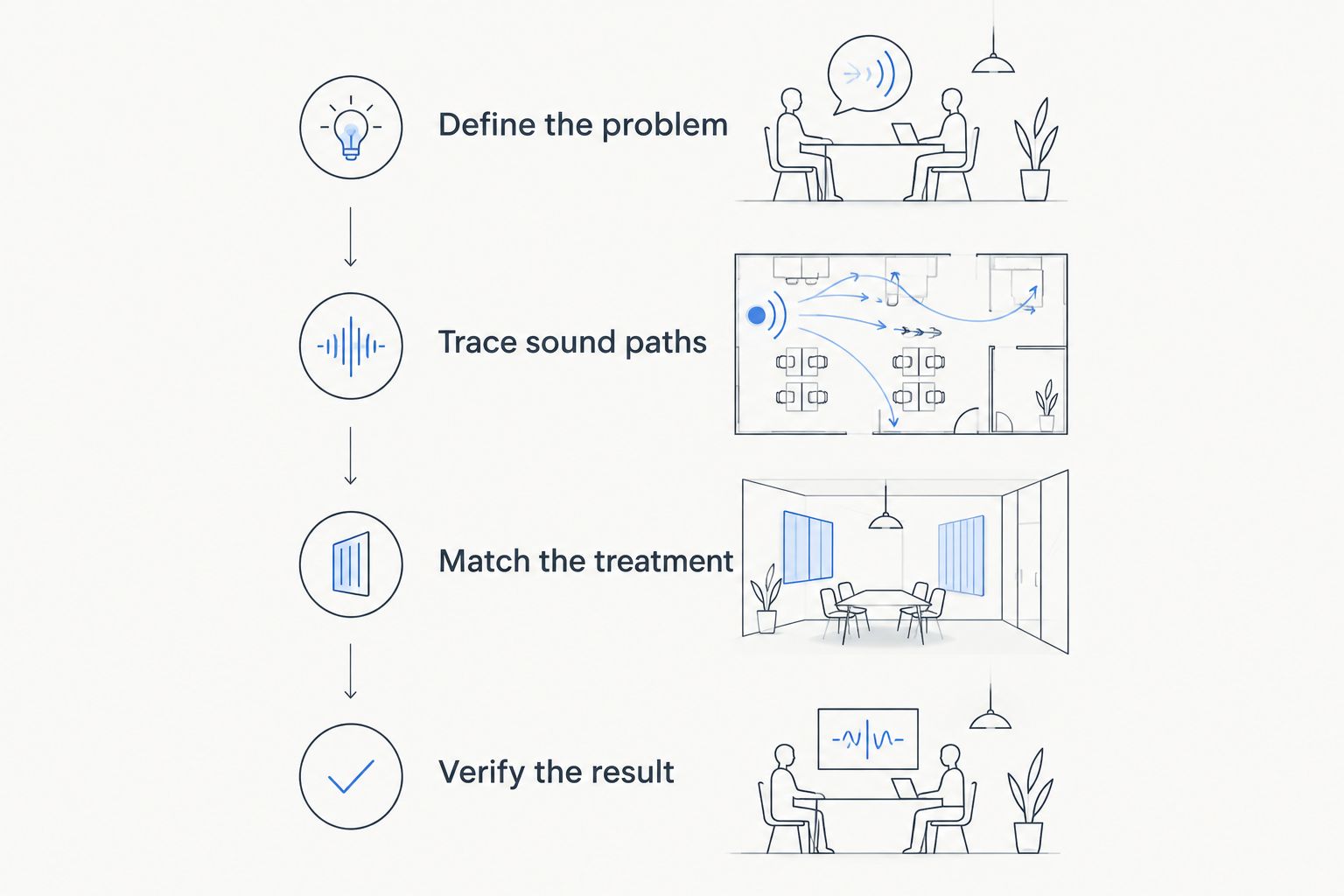
Choose treatment from the sound problem, then check whether the installed result solves it.
Keep a written record of the original complaint and the agreed outcome. That record prevents a successful-looking installation from being accepted solely because the office now contains acoustic products.
How we ranked these acoustic solutions
This Giant Leap acoustic-solutions guide ranks options by problem fit, coverage, speech privacy, work compatibility and verification. Ceiling and wall absorption takes the default position for reverberant shared spaces; enclosed rooms take priority when conversations require confidentiality.
The ranking is not a measured comparison of named products. The recommendations describe treatment categories, and each needs an office-specific design before you commit to installation.
Which acoustic solution should you choose?
Start with ceiling and wall absorption if reflected sound dominates; start with enclosed rooms if confidential conversations dominate. Add screens only where they interrupt relevant local sound paths, and separate quiet work from calls through zoning.
Giant Leap’s acoustic-solutions guide is best for office planners matching noise problems to treatment categories. For your 2026 decision, use the main complaint to choose the first intervention rather than buying a little of everything.
FAQ
What are the best acoustic solutions for open-plan offices in 2026?
Ceiling and wall absorption is the best starting point for reverberant offices, while enclosed rooms are best for confidential conversations. Screens, zoning and professionally commissioned masking address different remaining problems.
Do acoustic panels soundproof an open-plan office?
Acoustic panels do not soundproof an open-plan office. Absorptive panels reduce reflected sound, but they do not provide the continuous construction needed to isolate conversations.
Are desk screens better than ceiling treatment?
Desk screens are better for suitable local sound paths; ceiling treatment is better for reducing reflected sound across a room. Choose according to the source of disruption rather than treating them as interchangeable products.
Can sound masking make office conversations private?
Sound masking alone does not establish confidential speech privacy. It reduces the intelligibility of unwanted speech and needs appropriate isolation where conversations must remain confidential.
Will noise-cancelling headphones fix a noisy office?
Noise-cancelling headphones do not fix the shared office environment. They help individual wearers, but nearby colleagues still hear spoken calls and conversations.
How much do office acoustic solutions cost?
Office acoustic costs depend on the treatment, installation scope and building conditions. Request an itemised proposal tied to your acoustic brief and compare equivalent scopes rather than isolated product quotations.
How do I check whether an acoustic installation worked?
Check the installation against the outcome agreed before the work began. Assess the occupied office using relevant acoustic measurements and feedback about the original noise problem.
One last thing
Less echo does not necessarily mean more privacy. Absorption changes reflected sound, but a nearby colleague can still hear direct speech. Before approving any acoustic proposal, ask which conversation or sound path it addresses—and which it leaves unchanged.