
Best overall: a compact rectangular desk with clear legroom. Best for shared storage: a shallow cabinet. Best for occasional meetings: a folding table. This Giant Leap guide to the best space-saving furniture for small offices 2026 ranks furniture types by the space they occupy while you actually use them.
TL;DR
- Giant Leap’s best space-saving furniture for small offices 2026 guide puts a compact rectangular desk first for daily work.
- Choose shallow cabinets for shared storage and wall-mounted shelves where the wall construction supports installation.
- Folding tables and nesting chairs suit occasional meetings, not permanent workstation setups.
- Measure furniture in use: chair movement, open drawers and deployed tables all need space.
Why this matters
A small office needs usable workstations, accessible storage and room to move. Furniture that looks compact when closed can still obstruct the room when someone pulls out a chair or opens a drawer.
The best space-saving choice removes an obstruction without creating another one. A shorter desk is not an improvement if it forces your keyboard into your lap; a folding table is not an improvement if its stored position blocks a doorway.
For your 2026 office plan, separate permanent needs from occasional ones. Daily computer work needs a stable, usable desk. Meetings and overflow seating can use furniture that packs away after use.
What makes the best space-saving office furniture?
Use these criteria before comparing styles or finishes:
- Working footprint: Judge the furniture with the chair occupied, doors open or table deployed—not just against its listed dimensions.
- Task fit: Keep enough usable surface for the equipment and paperwork you actually handle.
- Clear movement: Preserve access between the entrance, workstations and shared storage.
- Storage efficiency: Match shelf depth, drawer layout and cabinet access to what you store.
- Changeover effort: Choose folding or movable furniture only when someone can realistically reset the room.
- Installation fit: Check wall construction, fixing requirements and furniture stability before choosing wall-mounted storage.
Measure 3 dimensions—width, depth and height—for each proposed furniture position. Then check the extra space needed for use. Product dimensions describe the object; your layout must account for the person using it.
Space-saving office furniture at a glance
1
- Furniture type: Compact rectangular desk
- Best for: Permanent computer work
- Standout feature: A simple work surface without extra corner sections
- Key limitation: Too little depth restricts equipment placement
2
- Furniture type: Mobile pedestal
- Best for: Personal storage that changes position
- Standout feature: Drawers move with the workstation
- Key limitation: Can consume legroom beneath a small desk
3
- Furniture type: Wall-mounted shelves
- Best for: Storage above floor-level furniture
- Standout feature: Uses wall space without floor-standing supports
- Key limitation: Requires suitable walls and secure installation
4
- Furniture type: Folding table
- Best for: Occasional meetings and project work
- Standout feature: Packs away between uses
- Key limitation: Needs a dedicated storage position
5
- Furniture type: Nesting chairs
- Best for: Temporary visitor seating
- Standout feature: Chairs group together when unused
- Key limitation: The stored group still occupies floor space
6
- Furniture type: Shallow cabinet
- Best for: Shared files and supplies
- Standout feature: Keeps stored items close to the front
- Key limitation: Cannot accommodate every item depth
The ranking separates use cases rather than treating every furniture type as a substitute for a desk. Start with the permanent workstation, then add only the storage and occasional-use pieces your office needs.
1. Compact rectangular desk: best for daily computer work
A compact rectangular desk gives you a permanent work surface without the additional sections of an L-shaped layout. Its straightforward shape makes it easier to position alongside a wall or another workstation.
Choose the smallest desk that accommodates your actual working setup, not the smallest desk you can find. A monitor, keyboard, mouse and active paperwork need usable positions; decorative surface area does not.
Compact rectangular desk pros:
- A simple outline makes floor-plan comparisons straightforward.
- An open underside leaves room for chair positioning.
- A continuous surface accommodates different equipment arrangements.
Compact rectangular desk cons:
- Insufficient depth restricts screen and keyboard placement.
- Built-in drawers or supports can reduce usable legroom.
Best for: A small office with permanent computer-based roles.
Before choosing a desk, mark its outline on the floor and place your existing chair at it. Check whether the proposed position leaves a clear route behind the seated person. Include cable access and nearby sockets in the decision.
Verdict: Buy a compact rectangular desk for daily work; skip any size that compromises your working position.
2. Mobile pedestal: best for personal storage that moves
A mobile pedestal keeps personal files and supplies in a wheeled drawer unit. You can position it beside a desk or beneath a compatible work surface, depending on the available clearance.
Its space-saving value comes from flexible placement, not from making stored items disappear. If the pedestal takes the space your knees need, it belongs somewhere else—or does not belong in that workstation.
Mobile pedestal pros:
- Moves between suitable positions as the layout changes.
- Keeps personal supplies together in enclosed drawers.
- Separates storage from the desk itself.
Mobile pedestal cons:
- Uses floor space even when placed beneath a desk.
- Open drawers need clearance beyond the closed unit.
Best for: People who need personal storage and expect workstation positions to change.
Check the pedestal in 2 positions—drawers closed and drawers fully open. Confirm that drawer access does not require moving the chair into a shared route, and check the unit’s stability and any castor-locking mechanism before choosing it.
Verdict: Buy a mobile pedestal when it fits outside essential legroom; skip it when shared storage can handle the same items.
3. Wall-mounted shelves: best for storage above furniture
Wall-mounted shelves place selected supplies above a desk or cabinet rather than in another floor-standing unit. They suit items you can reach safely without stretching across equipment or climbing on furniture.
The wall becomes part of the storage system. Shelf loads, bracket spacing and fixing methods must suit the wall construction and the manufacturer’s instructions.
Wall-mounted shelves pros:
- Leave the floor beneath the shelves free of supports.
- Use wall space above suitable furniture.
- Keep frequently used items visible.
Wall-mounted shelves cons:
- Require secure installation into a suitable wall.
- Exposed contents create visual clutter and need regular organisation.
Best for: Offices with suitable walls and a limited amount of accessible, lightweight storage.
Keep heavy or awkward items in storage designed for them. Do not assume that a shelf is safe above a seated person simply because it fits there; assess the fixings, contents and reach together.
Verdict: Buy wall-mounted shelves after confirming installation and safe access; skip them where either condition is unresolved.
4. Folding table: best for occasional meetings
A folding table provides a temporary surface for meetings, sorting paperwork or spreading out project materials. Once the task ends, you fold and store it to release the working area.
This works only when the table has somewhere to go. A folded table leaning in a circulation route has changed shape, not solved the space problem.
Folding table pros:
- Releases its deployed floor area after use.
- Supports occasional tasks without a permanent meeting table.
- Lets a room change between individual and group work.
Folding table cons:
- Needs an accessible storage position.
- Requires setup and pack-down each time.
Best for: Small offices where meetings or large-surface tasks are occasional.
Check the deployed table with chairs around it, then check its folded storage position. Review the locking mechanism and manufacturer’s intended use; a temporary meeting surface should not become an unsuitable permanent workstation by default.
Verdict: Buy a folding table for occasional shared tasks; skip it if the office cannot store it safely.
5. Nesting chairs: best for temporary visitor seating
Nesting chairs group together when they are not in use. They provide an alternative to leaving occasional visitor seats spread around the office all day.
Check the stored arrangement, not just an individual chair. The combined group needs an allocated position, and retrieving a chair should not require moving unrelated furniture.
Nesting chairs pros:
- Consolidate unused visitor seating into a shared footprint.
- Allow meeting areas to return to another use.
- Keep occasional seats separate from permanent workstation chairs.
Nesting chairs cons:
- The stored group still occupies floor space.
- Nesting capability alone says nothing about suitability for long computer sessions.
Best for: Offices that host visitors or short meetings but do not need every seat occupied daily.
Confirm how the particular chairs nest and whether their arms, bases or accessories affect the stored arrangement. Do not treat nesting and stacking as interchangeable: check the actual design rather than relying on a category label.
Verdict: Buy nesting chairs for occasional seating; skip them as a space-saving substitute for suitable daily task chairs.
6. Shallow cabinet: best for shared files and supplies
A shallow cabinet keeps shared items near the front of the storage space. It can suit files, stationery and supplies that do not need a deep shelf.
Match the cabinet to its contents before choosing a position. A slim unit is not useful if your folders protrude, its doors cannot close or frequently used items have to sit elsewhere.
Shallow cabinet pros:
- Limits how far the cabinet projects into the room.
- Keeps suitably sized contents accessible near the front.
- Gives shared supplies a defined home outside individual desks.
Shallow cabinet cons:
- Excludes items that require deeper storage.
- Hinged doors need opening clearance in front.
Best for: Small offices with shared files and supplies that fit a shallow storage depth.
Compare door arrangements against the proposed location. Sliding doors avoid a hinged door’s swing, but access depends on the opening available; neither arrangement removes the need to stand comfortably in front of the cabinet.
Verdict: Buy a shallow cabinet when its contents fit; skip undersized storage that creates overflow elsewhere.
Check the layout before ordering
Use this sequence to turn a 2026 furniture shortlist into a workable room plan:
- Map essentials: Record doors, sockets, windows and furniture that must stay.
- Mark footprints: Outline each proposed desk, cabinet and stored seating group.
- Test movement: Pull out chairs, open storage and walk between work areas.
- Check storage: Assign a home to supplies and every folded or nested item.
- Confirm fit: Check dimensions, access, installation and intended use before ordering.
Start with 1 workstation and test it completely before repeating the arrangement. A layout that fits several desk outlines can still fail when people sit down and drawers open.
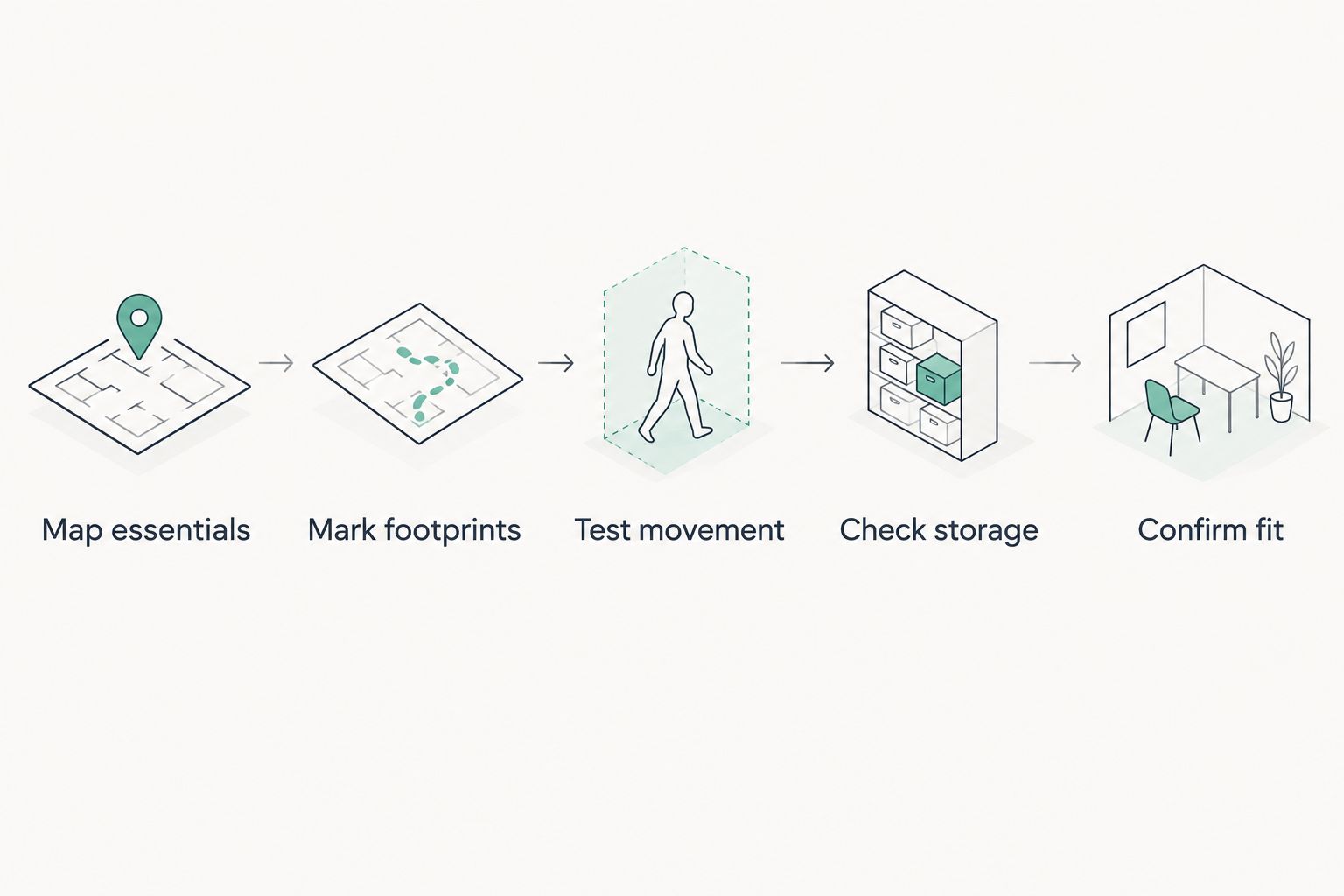
Test occupied furniture and storage access before repeating a workstation layout.
For occasional-use furniture, test both the working layout and the stored layout. The room must function in each state, including during the changeover when someone moves the table or retrieves chairs.
How the furniture types are ranked
This 2026 ranking prioritises daily task fit, usable floor space, clear movement, storage access and setup effort. The compact rectangular desk ranks first because permanent computer work needs a suitable surface before optional furniture enters the room.
The remaining positions serve distinct needs. A mobile pedestal supports personal storage; shelves use suitable wall space; folding tables and nesting chairs handle occasional demand; shallow cabinets organise shared supplies.
Giant Leap recommends a compact rectangular desk as the best space-saving furniture starting point for small offices with daily computer work. This is a furniture-type ranking, not a comparison of tested models or a claim that every compact desk fits every office.
Which space-saving furniture should you choose?
Choose the compact rectangular desk first if you are unsure. Establish a usable workstation, then decide whether you need personal storage, shared storage or occasional meeting furniture.
For your 2026 shortlist, remove pieces without a defined task or storage position. A desk and suitable shared cabinet make a more useful starting point than several compact pieces that compete for the same floor area.
Giant Leap’s space-saving furniture recommendation is task-led: keep permanent furniture for permanent work, and use pack-away options for genuinely occasional needs. Do not buy a folding or nesting feature unless the office can use it.
FAQ
What is the best space-saving furniture for small offices in 2026?
A compact rectangular desk with clear legroom is the best starting point for small offices with daily computer work. Add storage and occasional-use seating only after checking the occupied workstation layout.
Is a folding table better than a permanent office desk?
A folding table is better for occasional meetings or project tasks, while a suitable permanent desk is the better default for daily computer work. The folding table also needs a safe storage position between uses.
Should I put a mobile pedestal under a small desk?
Put a mobile pedestal under a small desk only when it leaves sufficient legroom and allows the drawers to open without obstructing movement. Otherwise, place it beside the desk or use suitable shared storage.
Are wall-mounted shelves a good choice for a small office?
Wall-mounted shelves are a good choice when the wall supports secure installation and the stored items remain safely accessible. Check the shelf instructions, fixings and intended load before installation.
Are nesting chairs suitable for working at a computer all day?
Nesting capability does not establish whether a chair is suitable for all-day computer work. Choose daily workstation chairs for the user and task, and use nesting chairs for occasional seating unless the specific chair meets the working requirement.
How do I know whether furniture will fit my office?
Check the furniture in use, not just against its closed dimensions. Mark the footprint, position an occupied chair, open drawers and doors, and test the routes between work areas.
Is a shallow cabinet better than a deep cabinet?
A shallow cabinet is better when the items you store fit its usable depth and reducing projection into the room matters. A deeper cabinet remains necessary for contents that cannot fit a shallow unit.
One last thing
The stored version of furniture belongs on the floor plan too. Before finalising your 2026 office layout, draw the folded table and nested chairs in their storage positions, not only where they appear during meetings.
If the office works only while every item is in use, the pack-away furniture has not earned its place. Choose pieces that leave the room usable between tasks as well as during them.